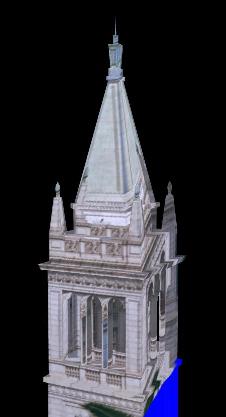
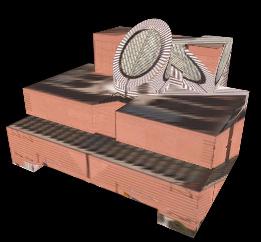
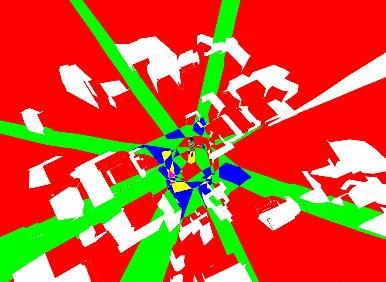
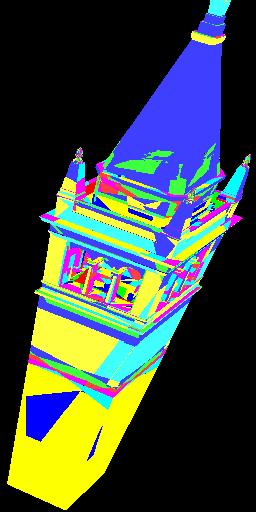
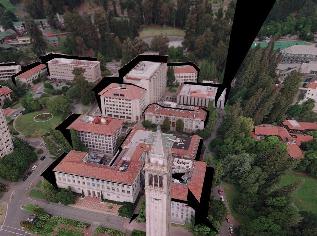
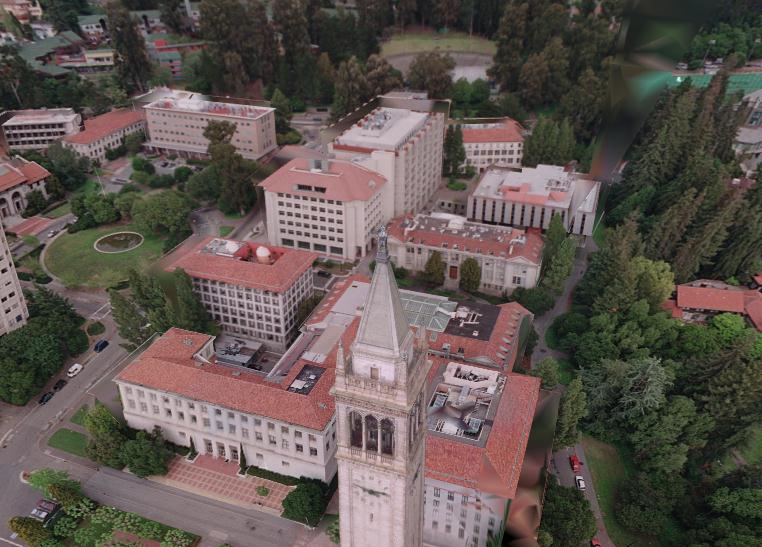
Projective texture-mapping is a powerful tool for image-based rendering. However, visibility information must be obtained in order to project correct textures onto the geometric sturcture without having textures piercing through the 3D structures and got mapped to occluded areas, which is unfortunately a result given by pure hardware projective texture mapping on most SGI workstations. We present a novel visibility algorithm for determining which polygons are visible from each camera position. It has object-space precision, but operates in both image-space and object-space to get better performance. Partially visible polygons are clipped in object-space. It generates much less polygons than traditional object-space algorithms to help accelerate the speed of texture-mapping. The techniques used to achieve these are conservative image-space occlusion test and object-space shallow clipping. This algorithm has been successfully used to generate large-scale image-based rendering of UC Berkeley campus, and image-based rendering of architectures under dynamic lighting. The following images show some of our results.
Paper pdf file as it appears in Journal of Computers & Graphics.